AEO & GEO
Google Now Shows You AI Overview Impressions, But Not Clicks
Google’s Search Console now includes a generative AI performance report that shows how often your pages appear in AI Overviews, AI Mode, and AI features in Discover. It reports impressions only, with no clicks, no position, and no query data. That makes it a useful visibility signal for AEO and GEO, but not a traffic report, so you need to pair it with your regular Search Console and analytics data.
What the new report actually shows
Google began rolling out the generative AI performance reports in Search Console in June 2026 and reported the worldwide rollout as complete on August 31, according to Search Engine Journal. The report counts an impression whenever one of your URLs appears in AI Overviews, AI Mode, or the generative AI features in Discover. You can slice the data by page, country, and date, and the Search version adds a device breakdown.
Think of it as the first official answer to a question every site owner has been asking: is Google citing my pages in its AI answers? Until now, that meant guessing or paying for third-party tracking tools. Now there is a first-party number, and for most sites that is a real step forward for AEO and GEO reporting.
What the report leaves out
The gap is just as important as the data. The report does not include clicks, average position, click-through rate, or a query-level breakdown. So you can see that a page was shown inside an AI answer, but not whether anyone visited, and not which search triggered it. Google’s own announcement acknowledged it does not include click data at publication.
Also, sites without enough AI impressions may not see a report at all, and Google’s help pages indicate the rollout is still settling. If your property shows nothing yet, that does not automatically mean your content is invisible to AI. It may only mean you are below the reporting threshold.
Google is also testing tracking parameters on AI links
The click gap may not last. In its October 2 recap, Search Engine Roundtable reported that Google is testing URL tracking parameters on links inside AI Overviews and AI Mode so publishers can tell where AI-driven visits come from. It is a test, not a launch, so do not build your reporting around it yet. But it signals that Google knows measurement is the next thing publishers are demanding.
Google is also testing small payments to roughly 100 publishers for content used in AI features, reportedly around 0.1% of ad revenue, which tells you how Google currently values being cited versus being clicked. Treat both items as early signals, not settled policy.
Why this matters for SEO, AEO, and GEO
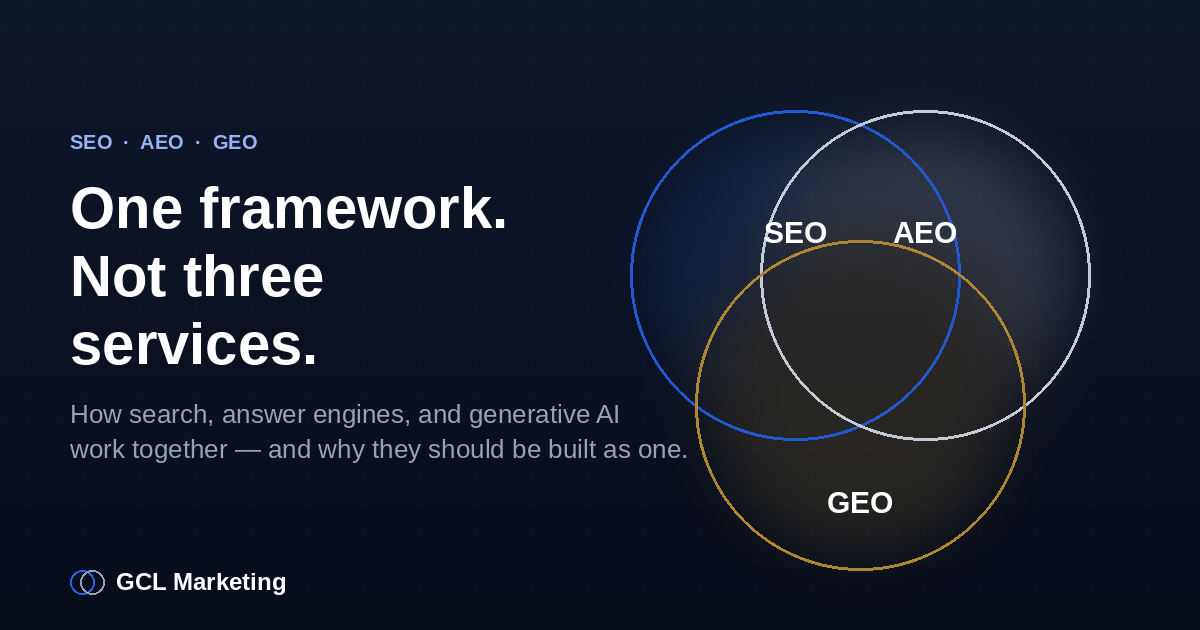
For years, SEO reporting stopped at rankings and clicks. AEO asks whether you are the answer an engine quotes. GEO asks how generative systems describe your brand. The new report is the first time Google hands you a number for those last two layers. That is why we treat the three as one framework, not three separate services: the same pages earn the ranking, the citation, and the description.
It also connects to quality. Google’s recent guidance says unchecked AI output is out of step with its documentation, which we covered in our post on the AI content fact-check rule, and the September 2026 spam update is still working through scaled low-effort content. Pages that are accurate and original are the ones most likely to be cited, so the impressions you see in this report are partly a quality score. And since search intent and content quality already top the ranking factors experts rate highest, the work you do for rankings carries straight into AI visibility.
What to do this week
- Check whether the report is live for your property. Open Search Console and look for the generative AI performance report. If it is missing, note the date and check again in a few weeks, since low-volume sites may not qualify yet.
- Export your top cited pages. Sort by impressions and save the top 20 URLs with the date range. This becomes your baseline before you change anything.
- Compare AI impressions against clicks in the regular Performance report. For each top page, note whether Search clicks rise, fall, or stay flat as AI impressions grow. That divergence is the metric Google does not give you directly.
- Strengthen the pages that already get cited. Add a short answer-first summary, a clear source for each statistic, and updated schema that matches reality, so the pages Google already trusts become easier to quote.
- Leave the AI opt-out alone unless you have a legal reason. The Search Console setting excludes you from the three AI surfaces, and Google says it is not used as a ranking signal elsewhere in Search. For most businesses, opting out means losing visibility with nothing gained.
- Set up a monthly AI visibility check. Record impressions, clicks, and branded searches in one simple sheet, so you can spot a trend instead of reacting to a single week.
The bottom line
Google just gave site owners the first official measure of AI visibility, and it is incomplete on purpose or by timing. Impressions tell you that you are being cited. Only your own analytics tell you whether that citation brings customers. Businesses that track both will make better decisions than those waiting for Google to close the gap.
If you want help turning these numbers into a plan, our SEO services include AI visibility reporting alongside rankings and traffic, so you can see all three layers in one place. You can also read how we approach SEO, AEO, and GEO as one strategy on our homepage, or browse more articles by topic.
Does Search Console show clicks from AI Overviews?
No. The generative AI performance report shows impressions only. It does not include clicks, average position, click-through rate, or query-level data.
Which AI features does the report cover?
It covers impressions in AI Overviews, AI Mode, and the generative AI features in Discover, filterable by page, country, and date.
Should I opt out of AI features in Search Console?
For most sites, no. Google says the setting is not used as a ranking signal, but opting out removes your content from AI surfaces and offers no ranking benefit.
Can I track AI Overview traffic in Google Analytics?
Not reliably yet. Google is testing URL tracking parameters for AI Overview and AI Mode links, but it is still a test, so compare Search Console impressions with your regular clicks for now.