
Category: AEO

  • Google Warns Against Fake Authors as a Bigger Ranking Update Looms

    Google Warns Against Fake Authors as a Bigger Ranking Update Looms

    Google Calls Fake Authors Deception, and a Bigger Update May Be Close

    Quick Answer

    On October 1, 2026, Google updated its people-first content guidance to say that fabricating creator profiles, such as AI-generated headshots, made-up names, or false credentials, is a form of deception. Search Engine Journal now expects a larger ranking update before the end of 2026 that rewards authentic, satisfying content. If your bylines, author pages, or credentials are not real and verifiable, fix them before that update lands.

    What Google changed on October 1

    Google added a plain warning to its helpful content guidance: fabricating creator profiles to make content look like it was written by human experts is deception. It names three red flags, which are AI-generated headshots presented as real authors, made-up names with no person behind them, and false credentials such as posing as a medical professional. Search Engine Journal reports that Google treats these as signals of a low-quality page that undermines trust with both users and automated systems.

    This is not a brand new idea. The same deception examples have appeared in Google’s Search Quality Rater Guidelines since at least May 2025. What changed is that the advice now sits in the documentation written for site owners, which is usually a sign that Google wants its systems and its guidance to point the same way.

    Why SEOs expect a bigger ranking update

    In an October 5 analysis, Search Engine Journal argued that Google is likely to ship a major ranking update before the year ends. Its reading of the recent guidance changes points to four themes: a stronger focus on user satisfaction, more weight on authentic content, a revised approach to fan-out queries, and possibly new content quality algorithms. Google also reworded its page quality guidance to say the quality of the main content is one of the most critical factors, and it widened the definition of main content to include tools, calculators, and user contributions.

    Treat this as informed expectation, not an announcement. Google has not confirmed a date or a name. What is confirmed is the recent rhythm: the September 2026 spam update began on September 24 with a second phase on September 30, and Search Engine Roundtable logged heavy ranking volatility that weekend. Spam updates, guidance rewrites, and a likely core-style update all push in the same direction.

    Google’s 2026 Quality Signals, in OrderConfirmed updates, plus the one SEOs expect nextMay 21CoreupdateJun 24SpamupdateAug 18SpamupdateSep 24Spam update,phase two Sep 30Oct 1Fake authorguidanceExpectedRanking updatebefore year endEvery step rewards real, accurate, human-backed content.gclmarketing.com

    Where SEO, AEO, and GEO meet

    Authorship is not just a ranking detail. AI Overviews and answer engines choose sources they can trust, and a byline with a real person behind it is one of the easiest trust signals to verify. That is why we treat the three as one framework, not three separate services: the same credible page earns the ranking, the citation, and the description. If you can already see AI visibility in the new Search Console AI report, authentic authorship is one of the cheapest ways to protect it.

    It also ties back to quality control. Google recently said a human should review AI drafts, which we covered in our post on the AI content fact-check rule. A real author who actually checks the work is the practical answer to both warnings. And since content quality already sits near the top of the ranking factors experts rate highest, none of this is a detour from normal SEO.

    What to do before the next update

    1. Audit every byline on your site. List each author name shown on posts and pages, and confirm a real person wrote or reviewed the content. Remove or replace any name that cannot be tied to someone.
    2. Replace any AI-generated headshots. Use a real photo of the actual author, or a clean logo or initials avatar if the person prefers not to appear. A plain avatar is better than a fake face.
    3. Verify every credential you claim. If an author bio says certified, licensed, or years of experience, make sure it is true and, where possible, link to a profile that proves it.
    4. Build real author pages. Give each author a page with their role, relevant experience, and links to their other work, then link bylines to it.
    5. Check main content quality on money pages. Add original examples, first-hand details, or a working tool or calculator where it fits, since Google now counts those as main content.
    6. Record a baseline before volatility hits. Export clicks and impressions for your top 20 pages from Search Console today, so you can tell real impact from noise if a larger update rolls out.

    The bottom line

    Google is lining up its guidance, its spam fighting, and its likely next ranking update around one idea: content should come from real people who actually know the topic. Fake authors are now named as deception, not just a weak signal. Fixing bylines and credentials is cheap, quick, and useful whether or not the next update arrives on schedule.

    If you want a second pair of eyes on your authorship and content quality, our SEO services include a trust and E-E-A-T review alongside rankings and AI visibility. You can also see how we approach SEO, AEO, and GEO as one strategy on our homepage, or browse more articles by topic.

    Is Google confirming a new ranking update?

    No. Search Engine Journal expects a major update before the end of 2026, based on recent guidance changes, but Google has not announced a date or name.

    Is using a pen name or company byline now a violation?

    Google’s warning targets fabricated profiles meant to pass content off as written by human experts. A clearly labeled company byline or editorial team is different, but do not invent a person or credentials.

    Can I still use AI to help write content?

    Yes, but a human should review and fact-check it, and the byline should reflect who actually stands behind the work.
  • Google Now Shows AI Overview Impressions in Search Console, But No Clicks

    Google Now Shows AI Overview Impressions in Search Console, But No Clicks

    Google Now Shows You AI Overview Impressions, But Not Clicks

    Quick Answer

    Google’s Search Console now includes a generative AI performance report that shows how often your pages appear in AI Overviews, AI Mode, and AI features in Discover. It reports impressions only, with no clicks, no position, and no query data. That makes it a useful visibility signal for AEO and GEO, but not a traffic report, so you need to pair it with your regular Search Console and analytics data.

    What the new report actually shows

    Google began rolling out the generative AI performance reports in Search Console in June 2026 and reported the worldwide rollout as complete on August 31, according to Search Engine Journal. The report counts an impression whenever one of your URLs appears in AI Overviews, AI Mode, or the generative AI features in Discover. You can slice the data by page, country, and date, and the Search version adds a device breakdown.

    Think of it as the first official answer to a question every site owner has been asking: is Google citing my pages in its AI answers? Until now, that meant guessing or paying for third-party tracking tools. Now there is a first-party number, and for most sites that is a real step forward for AEO and GEO reporting.

    What the report leaves out

    The gap is just as important as the data. The report does not include clicks, average position, click-through rate, or a query-level breakdown. So you can see that a page was shown inside an AI answer, but not whether anyone visited, and not which search triggered it. Google’s own announcement acknowledged it does not include click data at publication.

    Also, sites without enough AI impressions may not see a report at all, and Google’s help pages indicate the rollout is still settling. If your property shows nothing yet, that does not automatically mean your content is invisible to AI. It may only mean you are below the reporting threshold.

    Search Console’s AI Report: Seen vs. MissingGenerative AI performance report, rollout completed August 31, 2026What it shows1AI impressionsAI Overviews, AI Mode, Discover2By pagewhich URLs get shown3By country and datewhere and when you appear4By device (Search)desktop, mobile, tabletWhat it does not show1Clicksno traffic data from AI features2Average positionno ranking context3Click-through rateno way to judge citation value4Query breakdownno search terms behind the impressionVisibility is measurable now. Traffic from AI answers is not.gclmarketing.com

    Google is also testing tracking parameters on AI links

    The click gap may not last. In its October 2 recap, Search Engine Roundtable reported that Google is testing URL tracking parameters on links inside AI Overviews and AI Mode so publishers can tell where AI-driven visits come from. It is a test, not a launch, so do not build your reporting around it yet. But it signals that Google knows measurement is the next thing publishers are demanding.

    Google is also testing small payments to roughly 100 publishers for content used in AI features, reportedly around 0.1% of ad revenue, which tells you how Google currently values being cited versus being clicked. Treat both items as early signals, not settled policy.

    Why this matters for SEO, AEO, and GEO

    For years, SEO reporting stopped at rankings and clicks. AEO asks whether you are the answer an engine quotes. GEO asks how generative systems describe your brand. The new report is the first time Google hands you a number for those last two layers. That is why we treat the three as one framework, not three separate services: the same pages earn the ranking, the citation, and the description.

    It also connects to quality. Google’s recent guidance says unchecked AI output is out of step with its documentation, which we covered in our post on the AI content fact-check rule, and the September 2026 spam update is still working through scaled low-effort content. Pages that are accurate and original are the ones most likely to be cited, so the impressions you see in this report are partly a quality score. And since search intent and content quality already top the ranking factors experts rate highest, the work you do for rankings carries straight into AI visibility.

    What to do this week

    1. Check whether the report is live for your property. Open Search Console and look for the generative AI performance report. If it is missing, note the date and check again in a few weeks, since low-volume sites may not qualify yet.
    2. Export your top cited pages. Sort by impressions and save the top 20 URLs with the date range. This becomes your baseline before you change anything.
    3. Compare AI impressions against clicks in the regular Performance report. For each top page, note whether Search clicks rise, fall, or stay flat as AI impressions grow. That divergence is the metric Google does not give you directly.
    4. Strengthen the pages that already get cited. Add a short answer-first summary, a clear source for each statistic, and updated schema that matches reality, so the pages Google already trusts become easier to quote.
    5. Leave the AI opt-out alone unless you have a legal reason. The Search Console setting excludes you from the three AI surfaces, and Google says it is not used as a ranking signal elsewhere in Search. For most businesses, opting out means losing visibility with nothing gained.
    6. Set up a monthly AI visibility check. Record impressions, clicks, and branded searches in one simple sheet, so you can spot a trend instead of reacting to a single week.

    The bottom line

    Google just gave site owners the first official measure of AI visibility, and it is incomplete on purpose or by timing. Impressions tell you that you are being cited. Only your own analytics tell you whether that citation brings customers. Businesses that track both will make better decisions than those waiting for Google to close the gap.

    If you want help turning these numbers into a plan, our SEO services include AI visibility reporting alongside rankings and traffic, so you can see all three layers in one place. You can also read how we approach SEO, AEO, and GEO as one strategy on our homepage, or browse more articles by topic.

    Does Search Console show clicks from AI Overviews?

    No. The generative AI performance report shows impressions only. It does not include clicks, average position, click-through rate, or query-level data.

    Which AI features does the report cover?

    It covers impressions in AI Overviews, AI Mode, and the generative AI features in Discover, filterable by page, country, and date.

    Should I opt out of AI features in Search Console?

    For most sites, no. Google says the setting is not used as a ranking signal, but opting out removes your content from AI surfaces and offers no ranking benefit.

    Can I track AI Overview traffic in Google Analytics?

    Not reliably yet. Google is testing URL tracking parameters for AI Overview and AI Mode links, but it is still a test, so compare Search Console impressions with your regular clicks for now.

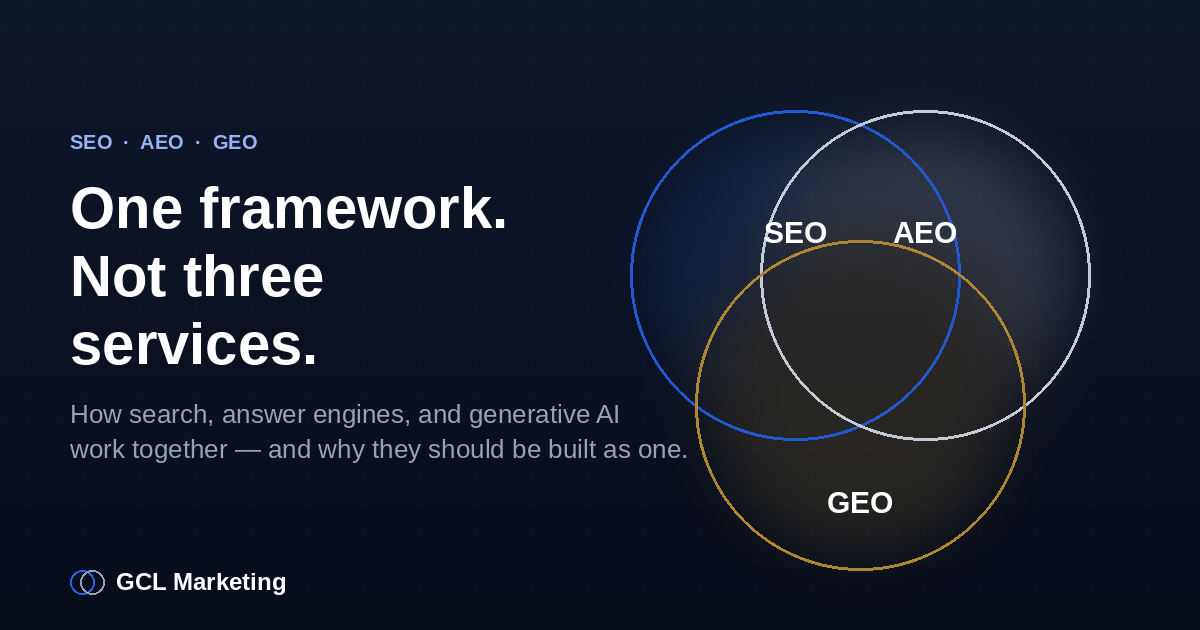
  • SEO, AEO, and GEO: Why They’re One Framework, Not Three Services

    SEO, AEO, and GEO: Why They’re One Framework, Not Three Services

    SEO, AEO, and GEO: Why They’re One Framework, Not Three Services

    Quick Answer

    SEO, AEO, and GEO all depend on the same underlying asset: clear, well-structured, genuinely useful content backed by a technically sound site. Selling them as three separate services fragments a budget that should be funding one connected system.

    Why this matters now

    Search behavior has split across more surfaces than it used to — traditional blue-link results, featured snippets and answer boxes, and AI-generated answers from tools like ChatGPT and Perplexity. Google’s own I/O 2026 announcements leaned further into AI-generated answers inside search itself, and data from SparkToro has tracked a rising share of searches that end without a click to any website at all. Agencies that treat SEO, AEO, and GEO as three separate invoices are asking clients to fund three efforts that actually draw from the same well.

    What SEO does

    Traditional SEO gets a page found and ranked in classic search results: technical crawlability, on-page relevance, and site authority. This is the foundation everything else sits on — see GCL’s Technical SEO and On-Page SEO services.

    What AEO does

    Answer Engine Optimization structures that same content so it can win the direct answer — a featured snippet, a voice search response, an FAQ box — rather than just a ranking position. It relies on clear, direct-answer formatting layered on top of solid SEO fundamentals, not a separate content strategy. See GCL’s AEO service.

    What GEO does

    Generative Engine Optimization is newer: making content something an AI answer engine can confidently cite and summarize accurately. It leans on the same content quality and clarity signals as SEO and AEO, plus added attention to source credibility and structured, quotable phrasing. See GCL’s GEO service.

    SEOAEOGEO
    GoalRank in search resultsWin the direct answerGet cited by AI answers
    Primary surfaceSearch results pageSnippets, voice, FAQsChatGPT, Perplexity, AI Overviews
    FoundationTechnical health + relevanceSEO + direct-answer structureSEO + AEO + source credibility

    Why splitting them into three services backfires

    Because AEO and GEO are both built on top of solid SEO, treating them as separate line items usually means paying three times for overlapping foundational work — or worse, getting AEO and GEO tactics layered onto a site with unresolved technical SEO problems underneath, which caps the return on all three. This is the reasoning behind GCL’s own framework, explained on the homepage.

    What does AEO stand for?

    Answer Engine Optimization — structuring content to win featured snippets, voice answers, and other direct-answer placements.

    What does GEO stand for?

    Generative Engine Optimization — optimizing content so AI tools like ChatGPT and Perplexity can accurately cite and summarize it.

    Should SEO, AEO, and GEO be bought as separate services?

    They can be, but since AEO and GEO both depend on strong underlying SEO, buying them separately often means paying repeatedly for the same foundational work.

    Does GEO replace traditional SEO?

    No. GEO builds on the same technical and content foundation as SEO — it doesn’t work well without it.

    Why is search behavior changing in 2026?

    More searches are being answered directly inside AI tools and search result pages themselves, reducing the share of searches that result in a click to a website.

    Related resources: See GCL’s full Services breakdown, learn more About GCL Marketing, or check Case Studies for verified results as they publish.

Schedule time with us